
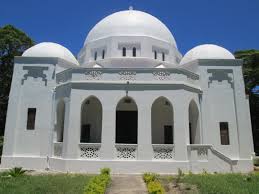
It was the first of its kind in all of East Africa and was used as a library for many historic survey. These include a valuable library of books on Zanzibar and east Africa. An attractive display of plaster bas- reliefs of fish, crustacean, painted in their natural colours can be found. The exhibits also include stuffed specimens of local birds, a small but useful herbarium of native plants, and a collection of shells.
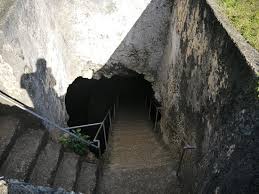
(Former English club): has a fine carved door and was formerly used as an English people who were then residents of Zanzibar.

The largest building ever seen in Zanzibar, was erected in 1883 by said barghash (sultan 1870-1888) for ceremonial purposes. It said to have been designed by a marine engineer. On the death of seyyid hamed (sultan 1893-1888), it was bombarded with adjoining buildings, by the British fleet during the brief usurpation of the throne by seyyid khalid, (the shortest war in history) but unlike the other buildings, it suffered comparatively little damage. The clock tower was added later to replace the former lighthouse, which stood by itself on the front close to the sea and was severely damaged in the bombardment. The clock tower at the entrance, stand two fine old Portuguese guns made not later then the middle of the 16th century. On the larger one are the Portuguese royal airms, the cipher and standard of king john lll, and a plan sphere of the world.
.jpg "about us")
Build in July 1887, to commemorate 50th anniversary of Queen Victoria reign. It housed a dispensary in the ground floor with a pharmacy and a resident doctor. Since its old dispensary has been hailed as a symbol of multi-cultural Zanzibar architecture. Its design, its rich decoration and its construction techniques are one of expectation quality. The plan of the u-shaped building –the traditional pattern and it’s characterized by series of rather small, mostly independent room arranged along the interior arcades facing a central courtyard.

It was bought by seyyid Barghash (Sultan 1870-1888) from an Arab of the Maruhubi tribe (hence the name); the estate is thickly planted with mango trees imported from India. The stone aqueducts were constructed for the supply of water from chem- chem spring to the palace and baths and for cultivation purposes. At the end of the avenue of mango trees are the artificial ponds adorned with blue water lilies (nymphoea capensis), a beautiful sight when in flower. Seyyid Barghash build the palace for the use of his harem in 1880- 1882. The walls surrounding the gardens are said to have cost English pounds 16,000(a large sum in those days), and to have inspired by the park walls seen by seyyid Barghash in 1875 when on a visit to England. The palace was accidentally burnt down in 1899, but some of the pillars that formally supported large balconies and part of the walls still remain. Adjoining the palace are the domed Persian baths from which however, the marble pavements and other embellishments have been removed, conversation under the domes produce strange echoes. The royal navy used the baths as magazine during the 1914-1918 wars.

Legally protected historical monument. This block of Persian style bath comprises the remains of country’s house of sultan seyyid said, Zanzibar ruler in 1804 -1856.Traditionally, the rest house was built for the use of his Persian wife, princess sherezade, the granddaughter of Mohammad shah of Persia. He married in 1847 a date 1247 A.H. - (1832 A.D) inscribed into stuccowork decorating the interior of the baths. If the time have built the baths before the marriage took place.
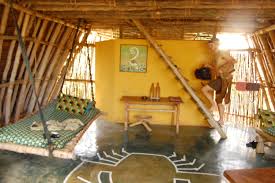
Is thought by some to have been one of the old capitals of the island. Traces of on old shirazian settlement, praying to be saved from his enemies, disappeared in a rock which opened and shut behind him. Near the walled enclosure is an ancient archaeological research, which may be entered with permission and provided the visitors shoes, are first removed, the most interesting part of the mosque is the ornate MIHRAB (corresponding to the altar in a Christian church) and the north wall, along which there is a frieze of passages from the koran. An inscription in kufic characters on the left of the MIHRAB given the date of the building of the mosque at A.H 500 (A.D.1107) nearby there is another inscription (in Arabic) which states at the mosque was repaired In A.H...1184 (A.D 1770) the mosque which is thought to be the only one on the East African coast where so much kufic exists. Has been the subject of a monograph by professor flurry of Cairo (the kufic inscriptions of kizimkazi mosque, Zanzibar AH 500(A.D 1107). The mosque is still in use to date. Outside is a well and graves of sheriffs (descendants of the prophet).

The house was once the residence of the well-known Arab traveler and trader, hamed bin Mohammed el-marjebi (tippu tip) who died in 1905. He is said to have earned his sobriquet from the fact that his red rimmed eyes resembled those of a small bird known locally as the tippu tip bird and scientifically by the name centropus supercilious. One of this sword s and other relics has been presented to the museum.

Was built by albusaidi family of Oman in the 17th century. They used it for the purpose of defending themselves against any threats from Portuguese or Oman rival groups. In the latter part of the 16th century the Portuguese established a trading depot of the site of the existing Arab fort. A church was also erected at a later date on the same spot. After the expulsion of the Portuguese, the Arabs used a material of those building to construct o fort. Early in the 18th century Fatima, whom Portuguese record describe as “queen” of Zanzibar, was living under close supervision somewhere in the vicinity of this fort. She remained loyal while the rest of the swahilis allied themselves with oman.

(palace museum) the building was first occupied by a reigning sovereign in 1911 when the late sultan seyyid sir khalfan bin haroub acceded before then it accommodated members of the royal family and the harem. General sir lioyd mathewes also lived for some time and eventually died in it. The walled garden is the site of former royal place beit el-sahil (the house near the sea) which was build at little before 1834 by seyyid said (sultan 1804- 1856) and destroyed in the bombardment of 1896. Now a museum- depicts the memoir of al- Busaid Dynasty.

Anchorage for dhows which visit Zanzibar in the northeast monsoon (December – March) and return in the south west monsoon (April - October). Some of these vessels are fine examples of oriental ship building and remain play an important part in trade between Zanzibar and other coastal towns of East Africa.

Now houses the offices of Zanzibar Tourist Corporation, was placed at the disposal of the famous explorer, Dr. David Livingstone, for some weeks when fitting out his last expedition to the mainland in 1866. It later become the properties of ithnasheri khoja- Indian community who used as a rest house for invalids and as a place of religious meeting to be known as sonbagh. In 1947 the government purchased it and renovated for the use of a laboratory for scientific research and living quarters.
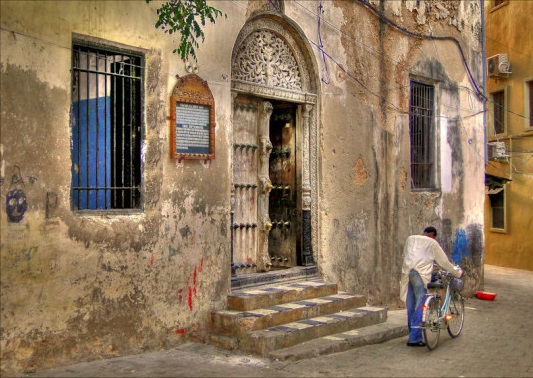
One of the country residences of his highness the sultan. This was built in1915 form the designs of Mr. J.H. Sinclair, C.M.G, C.B.E, (successively consul, chief secretary and British resident in Zanzibar from 1899- 1924). The palace and grounds are not open to the public.

Here lived the mwinyi mkuu, the last but one of a long dynasty of chiefs of supposed shirazian descent who were the rulers of Zanzibar before the permanent Arab settlement from Oman in the early 18th century. Their subjects looked upon the chiefs with the greatest awe and veneration. The builder of the existing ruins was born probably about 1785 and died in 1865. The palace, which was erected between 1845 and 1856, was pulled down in 1910 or 1911 and only a few of the walls remain, some of the archways and rooms on the ground floor can still be seen. Slaves are said to have been buried alive with in the walls. Some years ago the sacred Swahili drums and horns of carved wood were found here.