
.jpg "about us")
Zanzibar is a land of mysticism and beauty with a diverse landscape. It has bewildered the imagination of travelers throughout the ages of mankind. It is steeped in legend and mystery and known to be the last genuinely and unspoilt tourist destination with hundreds of years old civilization besides having many interesting places to bear witness to, it boasts to traditional hospitality where the and the new interact. Zanzibar has gained a respectable position among nations concerned with environmental protection, thus a case in point-eco- tourism. Thanks to the landscapes that offer many a touristic possibility-rich historical background, spectacular variety of fauna and water sports. The friendly people and exotic atmosphere abound, will make your stay an unforgettable one,.. So why wait until you hear from someone else. Let exotic tours to be your host and show you the splendor and exciting places on the island and to the world’s best game reserves that are found in the northern and southern Tanzania. Our carefully selected multilingual staffs portray courteous manner with immense knowledge of this mysterious and wonderful nation. Let them inspire and make your dreams came true as you discover fascinating history, adorable culture, and a thrill of adventure at its best.

TOWN MARKET: formerly known as Estella, market, which was named after Estella, countess cave, sister of general sir Lloyd Mathews (first minister of Zanzibar government) and widow of earl cave- fruit and vegetables of all kinds are sold in great profusion, while in the saidiyeh market which was opened in 1904 and named after the dynasty of sultans (Albusaid)- fish, meat and poultry are on sale.

The cathedral stands on the last slave market to open in Zanzibar. The Christian religion played a significant role and Britain in particular in suppressing the slave trade. The mission was directly inspired by appeal made by Dr.livingstone.

Beneath St. Monica s house lies underground chambers that were used to hold slaves for the nearby market. National museum: (peace memorial) –on the 11th November 1925bhis highness sultan seyyid sir khalfan bin haroub named it (bait el Amaan- the house of peace). Built as a peace memorial from funds subscribed by the Government and by the various committees, and founded largely owing to the enthusiasm of Dr.A.H . Surrier, its first curator, the museum was opened on armistice day, 1925. The architect was Mr.J.H.Sinclair, whose original sketches are preserved in the museum. The design derived from the type of a mosque and circular building, originated in Constantinople (Istanbul) by Mr. J.H. Sinclair, the architect. Due to the interest shown by the public and the growth of the activities of the museum, it was decided in1929 to build on extension to the existing premises, which was later opened in 1930. .
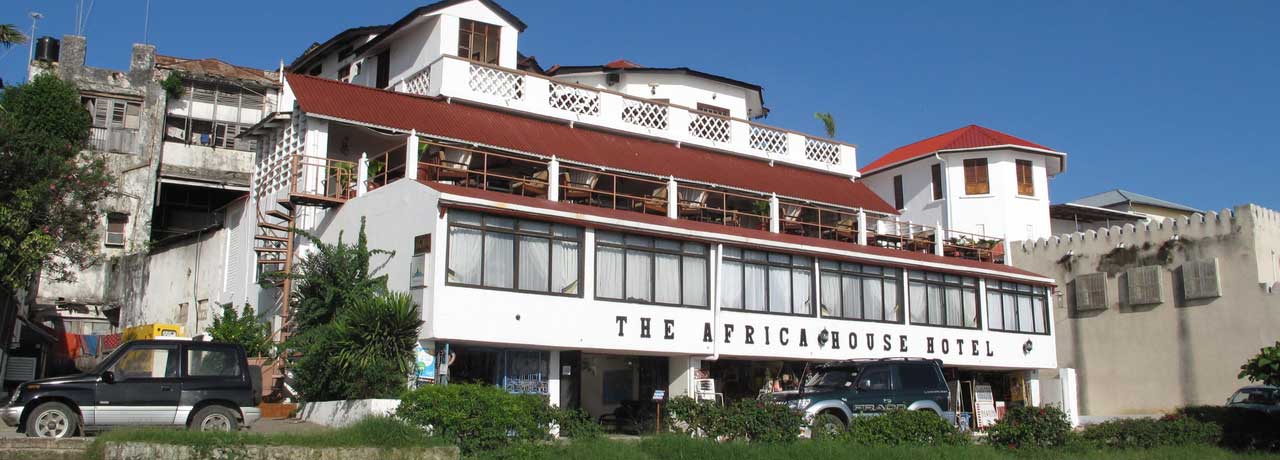
(Former English club): has a fine carved door and was formerly used as an English people who were then residents of Zanzibar.
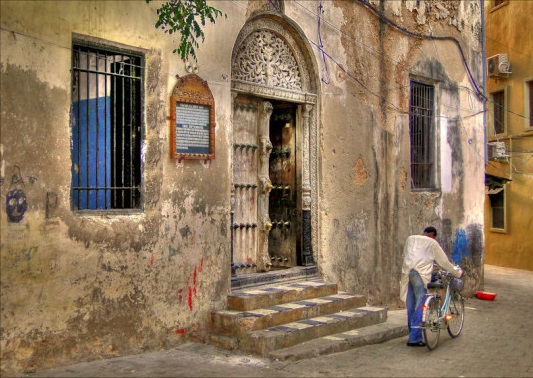
TIPPU TIP HOUSE: The house was once the residence of the well-known Arab traveler and trader, hamed bin Mohammed el-marjebi (tippu tip) who died in 1905. He is said to have earned his sobriquet from the fact that his red rimmed eyes resembled those of a small bird known locally as the tippu tip bird and scientifically by the name centropus supercilious. One of this sword s and other relics has been presented to the museum.
.jpg "company")
(palace museum) the building was first occupied by a reigning sovereign in 1911 when the late sultan seyyid sir khalfan bin haroub acceded before then it accommodated members of the royal family and the harem. General sir lioyd mathewes also lived for some time and eventually died in it. The walled garden is the site of former royal place beit el-sahil (the house near the sea) which was build at little before 1834 by seyyid said (sultan 1804- 1856) and destroyed in the bombardment of 1896. Now a museum- depicts the memoir of al- Busaid Dynasty.

Earth sea and sky, all seemed wrapped in a soft and sensuous repose”-mysterious-spice island of Zanzibar. The visitor to Zanzibar treads a path that has been worn by generation of travelers and sea adventurers for many centuries. Zanzibar comprises of Unguja and Pemba and other smaller islets within the territorial water. The islands cover land area of around 2300sq.meters. Zanzibar is the second largest island on the East Africa coast and is roughly 53 miles long by 24 miles broad (maximum measurements) with an area of 640 square miles.it lies in latitude 6*,S. longitude 39*E. and is separated from Africa continent by channel 22.5 miles wide across at its narrowest part. The highest point in Zanzibar is only 390 feet about sea level at Masingini-Dole also known as the “pink terraces”. Pemba, the smaller of the two islands, lies about 25 miles to the northeast Zanzibar and 30 miles from the mainland. It is some 300 yards long by 170 yards broad and is only about 10 feet above tide level. Zanzibar town is 135 miles from Mombasa , 45 from Dar es Salaam, 78 from Tanga, 1,607 from Durban and 6,323 from London. Through there are few records concerning Zanzibar, it is surmised that ancient races such as Sumerians, Assyrians, Hindus, Egyptians, Phoenicians and southern Arabians must have visited the East African coast from earliest times.it is probable that the indigenous tribes of Zanzibar (Wahadimu, Watumbatu, Wapemba) are descended from Bantu peoples of the East African, the Shirazis (a generic term applied to all non-Arab people of the Persian Gulf) and Arab, Swahili is a term originally applied by Arab to those of themselves who settled on the coast, and means of a man of the coastal region who is more African than Arab. The conversion of the coastal peoples to island probably dates from the beginning of the 10th century. Tawards the end of the same century people from the Persian Gulf and Southern Arabia established a number of outposts on the coast. Vasco da Gamma visited Zanzibar in 1499 on his return voyage from India. Early in the 16th century the Portuguese made themselves masters of the East African coast and in 1503 Zanzibar itself become tributary to Portugal.in the latter part of the same century, with the consent of the local ruler of the island, the Portuguese established a trading post, and later still erected a church of the peninsula where the town of Zanzibar now stands. In the early years of the 17th century Portuguese domination was seriously threatened by the capture of Ormuz by the Persians and the capture of Muscat by the Arabs of Oman in 1650. In east Africa the coast towns and island of Pemba rose in rebellion in 1631 and through that rising was ruthlessly suppressed in the course of the next few years, the Portuguese never really recovered from its effects. In 1698 the Arabs of Oman captured Mombasa, where the Portuguese had build a fort .thereafter the whole of the East Africa coast as far south as cape Delgado, including Zanzibar and Pemba, passed from Portuguese hands into Arab hand. Sayyid said bin sultan, the ruler of Oman and the founder of modern Zanzibar and of its French colonies of lle de France (Mauritius) and bourbon and the Spanish colonies in south America, Zanzibar had become a considerable depot for the great African slave trade, but when early in the 19th century, public option in Britain began to demand the suppression of the trade, seyyid said entered into agreement with the English for its restriction in his dominion. He also signed commercial treaties with the United States of America, Great Britain and France, for which country consulates were opened in the island in 1833, 1841 and 1844 respectively. In 1861, by a ward of lord canning, then governor –general of India, the imam s possessions in Africa become independent of Muscat and from that date Oman and Zanzibar have remained political separate. The next year seyyid barghash agreed by treaty with great Britain to prohibit the export of slaves from east Africa and to close all market in his dominions. Thereafter, the great slave market of Zanzibar (mkunazini) was abolished.
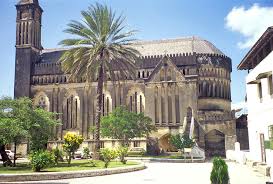
The foundation stone was laid in 1873. Bishop steered was the master builder and clerk of works and his devoted supervision meant to the fabric. His absence for a short period resulted in the marble pillars of the baptistery being erected upside down, the capitals serving as bases. That is how they are seen today.
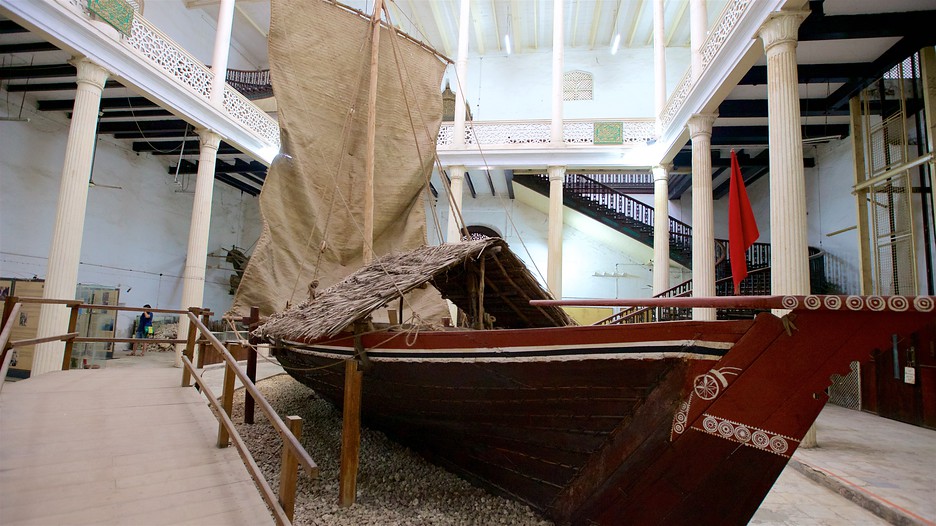
It was the first of its kind in all of East Africa and was used as a library for many historic survey. These include a valuable library of books on Zanzibar and east Africa. An attractive display of plaster bas- reliefs of fish, crustacean, painted in their natural colours can be found. The exhibits also include stuffed specimens of local birds, a small but useful herbarium of native plants, and a collection of shells.
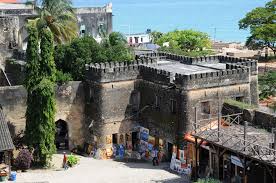
Was build by albusaidi family of Oman in the 17th century. They used it for the purpose of defending themselves against any threats from Portuguese or Oman rival groups. In the latter part of the 16th century the Portuguese established a trading depot of the site of the existing Arab fort. A church was also erected at a later date on the same spot. After the expulsion of the Portuguese, the arabs used a material of those building to construct o fort. Early in the 18th century Fatima , whom Portuguese record describe as “queen” of Zanzibar, was living under close supervision somewhere in the vicinity of this fort. She remained loyal while thee rest of the swahilis allied themselves with oman.
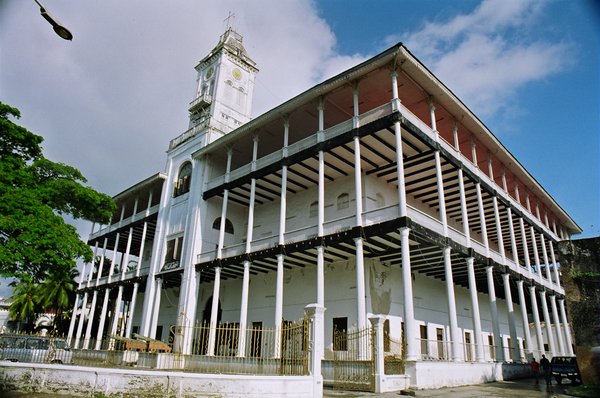
The largest building ever seen in Zanzibar , was erected In 1883 by said barghash (sultan 1870-1888) for ceremonial purposes. It said to have been designed by a marine engineer. On the death of seyyid hamed (sultan 1893-1888),it was bombarded with adjoining buildings, by the British fleet during the brief usurpation of the throne by seyyid khalid, (the shortest war in history)but unlike the other buildings, it suffered comparatively little damage. The clock tower was added later to replace the former lighthouse, which stood by itself on the front close to the sea and was severely damaged in the bombardment. The clock tower at the entrance, stand two fine old Portuguese guns made not later then the middle of the 16th century. On the larger one are the Portuguese royal airms, the cipher and standard of king john lll, and a plan sphere of the world.